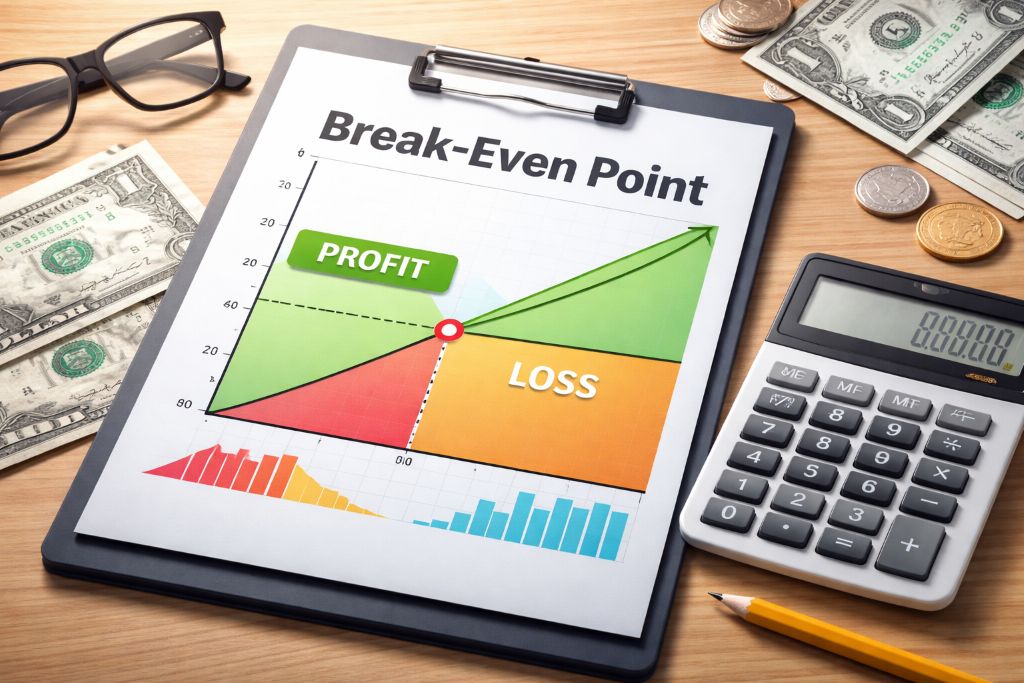
The break even point is the moment when a business stops losing money—but has not started making a profit yet. At this point, total revenue is just enough to cover total costs. Nothing more, nothing less. In simple terms, the break even point answers one basic question: how much do you need to sell before the business pays for itself? Until that point is reached, every sale helps reduce losses. After that point, each additional sale begins to contribute to profit.
What often confuses non-finance people is that break-even has nothing to do with how busy a business looks. A company can have steady sales, growing activity, and positive revenue—and still operate below its break even point. In that situation, the business feels active but continues to lose money in small amounts that accumulate over time. The reason the break even point matters is clarity. It separates activity from viability. Instead of asking whether sales are increasing, break-even forces a more direct question: is the business covering its costs yet? That single distinction is why break-even analysis remains one of the most practical tools for understanding business performance, even for people without a finance background.
Why the Break Even Point Matters More Than “Profit”
Many non-finance people assume profit is the ultimate measure of success. If revenue is higher than expenses, the business must be doing fine—at least on paper. The problem is that profit alone does not explain when a business becomes financially sustainable. The break even point matters because it marks the boundary between survival and vulnerability. Before reaching break-even, the business relies on external support—personal savings, loans, delayed payments, or tolerance for losses. After reaching break-even, the business can begin to support itself through operations.
Profit is usually reported over a period of time, such as monthly or annually. Break-even, on the other hand, focuses on thresholds. It answers questions like: How much volume is required before the business stops bleeding cash? and How far is the business from covering its fixed costs? These are operational questions, not accounting abstractions.
This distinction is especially important for pricing and growth decisions. A business can show accounting profit at the end of the year while still operating dangerously close to its break even point on a daily basis. In that situation, even a small drop in sales or a minor cost increase can push the business back into losses. By highlighting the minimum level of activity required to stay afloat, the break even point provides a clearer view of financial reality than profit figures alone. It turns vague performance indicators into concrete boundaries that business owners and managers can actually act on.
The Simple Math Behind Break-Even (No Finance Background Needed)
The math behind the break even point is simpler than it sounds. You do not need accounting training to understand it. At its core, break-even analysis uses three basic elements: fixed costs, variable costs, and selling price. Fixed costs are expenses that stay the same regardless of how much you sell. Examples include rent, basic salaries, insurance, and software subscriptions. These costs exist even if sales drop to zero.
Variable costs change with each sale. These include materials, packaging, transaction fees, or direct labor tied to production. Every additional unit sold increases variable costs. The break even point is calculated by dividing total fixed costs by the contribution margin per unit. In plain English, the contribution margin is how much money each sale contributes toward covering fixed costs after variable costs are paid.
The basic formula looks like this:
Break-Even Units = Fixed Costs ÷ (Selling Price − Variable Cost per Unit)
For example, if fixed costs are $10,000 per month, the selling price per unit is $50, and variable cost per unit is $30, then each sale contributes $20 toward fixed costs. The business must sell 500 units to break even. This calculation does not predict profit. It simply identifies the point where losses stop accumulating. Anything sold beyond that level begins to generate profit. Anything below it means the business is still operating at a loss, no matter how busy it feels.
The Core Components of Break-Even Analysis
Break-even analysis may look mathematical, but it rests on a small set of practical components. Understanding these elements helps non-finance readers see what actually moves the break even point—and what does not. The first component is fixed costs. These are expenses that do not change with sales volume in the short term. Rent, base salaries, insurance, utilities, and essential software typically fall into this category. Fixed costs define how much the business must cover before it can stop losing money.
The second component is variable costs. These costs rise with each unit sold. Materials, packaging, transaction fees, and direct production labor are common examples. Variable costs determine how much of each sale is available to cover fixed costs. The third component is selling price. This is the amount charged per unit or transaction. Small changes in price can significantly shift the break even point because they directly affect how much each sale contributes toward fixed costs.
The final component is the contribution margin, which is the difference between selling price and variable cost per unit. This margin represents the portion of each sale that helps pay off fixed costs. A higher contribution margin lowers the break even point; a lower margin raises it. Together, these components form the foundation of break-even analysis. The break even point moves when fixed costs change, when variable costs shift, or when pricing is adjusted. It does not move simply because the business becomes busier.
How Many Sales Until You Stop Losing Money?
The most practical way to think about the break even point is not as a formula, but as a sales threshold. It answers a simple and uncomfortable question: how many sales are required before the business stops losing money? Before reaching this threshold, every sale reduces losses but does not eliminate them. The business may feel productive, orders may be coming in, and revenue may look promising—but financially, it is still operating in negative territory. The break even point marks the exact moment when that changes.
This perspective is especially useful for day-to-day decision-making. Instead of asking whether sales are “good,” break-even forces a more concrete evaluation: are current sales sufficient to cover fixed costs yet? If the answer is no, the business is still relying on external support or cash reserves to survive.
Understanding break-even as a sales count also reveals why growth alone can be misleading. Increasing sales volume below the break even point improves optics but not sustainability. Only sales beyond that threshold create financial breathing room. For non-finance people, this reframing is critical. Break-even is not about maximizing profit—it is about identifying the minimum level of activity required to stop losing money. Everything else comes after that line is crossed.
Common Uses of Break-Even Analysis in Small Businesses
Break-even analysis is most useful when it is applied to real decisions, not treated as an abstract finance exercise. For small businesses, the break even point often acts as a practical reference line when evaluating everyday choices. One common use is pricing decisions. Before adjusting prices, break-even helps clarify how sensitive the business is to change. A small price decrease may require a large increase in sales volume just to stay at the same break-even level. Without this insight, pricing changes can quietly increase risk instead of improving competitiveness.
Break-even analysis is also useful for evaluating growth plans. When considering expansion—such as adding a new product, location, or service—the break even point shows how much additional volume is required to justify the added fixed costs. This prevents growth decisions from being based solely on optimism or surface-level demand. Another practical use is cost awareness. By clearly separating fixed and variable costs, break-even analysis highlights which expenses create long-term pressure. This helps business owners understand which costs must be covered regardless of sales, and which costs scale more flexibly with activity.
Finally, break-even analysis supports risk assessment. Knowing how close current sales are to the break even point provides a clear picture of vulnerability. A business operating just above break-even has little margin for error, while one operating comfortably above it has greater flexibility to absorb shocks. Used this way, break-even analysis becomes a decision tool rather than a calculation. It connects numbers directly to operational choices that affect survival and stability.
The Key Assumptions—and When Break-Even Can Mislead
While the break even point is a powerful tool, it relies on several assumptions that do not always hold in real-world business conditions. Understanding these assumptions is essential, especially for non-finance readers who may otherwise treat break-even figures as precise or absolute. One key assumption is that costs behave predictably. Break-even analysis assumes fixed costs remain fixed and variable costs change proportionally with sales volume. In practice, costs often shift in steps. Hiring additional staff, increasing capacity, or upgrading systems can suddenly raise fixed costs, moving the break even point higher than expected.
Another assumption is stable pricing. Break-even calculations typically assume the selling price does not change as volume increases. However, competitive pressure, discounts, or changes in customer mix can reduce effective prices, lowering contribution margins and pushing break-even further away.
Break-even analysis also assumes consistent demand. It does not account for seasonality, volatility, or short-term fluctuations. A business may reach break-even during peak periods but fall below it during slower months, creating financial strain that the average break-even figure fails to capture.
Finally, break-even analysis assumes capacity is sufficient. It does not consider operational constraints that limit how much the business can actually sell. Reaching break-even on paper does not guarantee the organization can sustain that level of activity without additional costs or inefficiencies. Because of these assumptions, break-even should be treated as a guide, not a guarantee. It provides a simplified view of financial reality—useful for orientation, but incomplete without context.
What Is a “Good” Break Even Point—and What It Depends On
There is no single number that defines a “good” break even point. What looks healthy for one business may be risky for another. The usefulness of a break even point depends entirely on context—industry structure, cost behavior, pricing power, and operating stability. In businesses with high fixed costs, a higher break even point is often unavoidable. Manufacturing, logistics, and service operations with dedicated staff or facilities typically need more volume before they stop losing money. In these cases, the risk lies not in the size of the break even point itself, but in how consistently the business can operate above it.
For businesses with lower fixed costs and higher margins, a lower break even point offers more flexibility. These businesses can survive sales fluctuations more easily because fewer transactions are required to cover baseline expenses. Here, a “good” break even point is one that leaves enough buffer for variability, not just one that is technically reachable.
Timing also matters. A break even point that is achievable only during peak periods may still expose the business to cash pressure during slower months. In contrast, a break-even level that can be met consistently across normal operating conditions provides greater financial resilience. Ultimately, a good break even point is not defined by how fast losses stop, but by how much room for error remains afterward. The more distance a business has between current sales and its break-even threshold, the more stable its financial position tends to be.
Bottom Line
The break even point does not tell you how profitable a business can become. It tells you something more fundamental: whether the business has crossed the line between losing money and sustaining itself. That distinction alone makes break-even analysis valuable, even for people without a finance background. Used correctly, the break even point clarifies decisions that are otherwise vague. It turns questions about growth, pricing, and costs into measurable thresholds. It shows how far current performance is from stability—and how sensitive the business is to small changes.
At the same time, break-even does not capture everything. It simplifies reality by assuming stable costs, pricing, and demand. It cannot predict volatility, operational strain, or cash timing issues on its own. Treating it as a guarantee rather than a guide can create false confidence. For non-finance decision-makers, the real value of break-even lies in perspective. It shifts attention away from how busy or active a business looks and toward whether the business structure actually supports itself. Once that line is understood, profit becomes meaningful—because the business is no longer just surviving.
References
- Corporate Finance Institute (CFI), https://corporatefinanceinstitute.com/
- AccountingTools, https://www.accountingtools.com/
- Investors.gov (U.S. SEC), https://www.investor.gov/
- MIT OpenCourseWare, https://ocw.mit.edu/
- QuickBooks Resource Center, https://quickbooks.intuit.com/
- BDC (Business Development Bank of Canada), https://www.bdc.ca/
- OpenStax (Rice University), https://openstax.org/
- Small Business Chron (Hearst), https://smallbusiness.chron.com/
Frequently Asked Questions (FAQ)
How do you calculate the break even point?
You calculate the break even point by dividing fixed costs by the contribution margin per unit. The contribution margin is the selling price minus the variable cost per unit.
Why is the break even point important for small businesses?
It shows the minimum sales volume required for the business to sustain itself. This helps owners understand risk, pricing decisions, and how close the business is to financial stability.
What are the main components of break-even analysis?
The main components are fixed costs, variable costs, selling price, and contribution margin. Changes in any of these will move the break even point.
Can a business still struggle after reaching the break even point?
Yes. Reaching break-even only means losses have stopped. Profit, cash flow timing, and operational stability depend on performance beyond the break-even level.